




LoRa Transceiver Radio Bonnet RFM69HCW
25,69€
In stock

 Do you have any further questions?
 RadioFruit: RFM69HCW Transceiver Radio Bonnet – 868 or 915 MHz (Europeo)
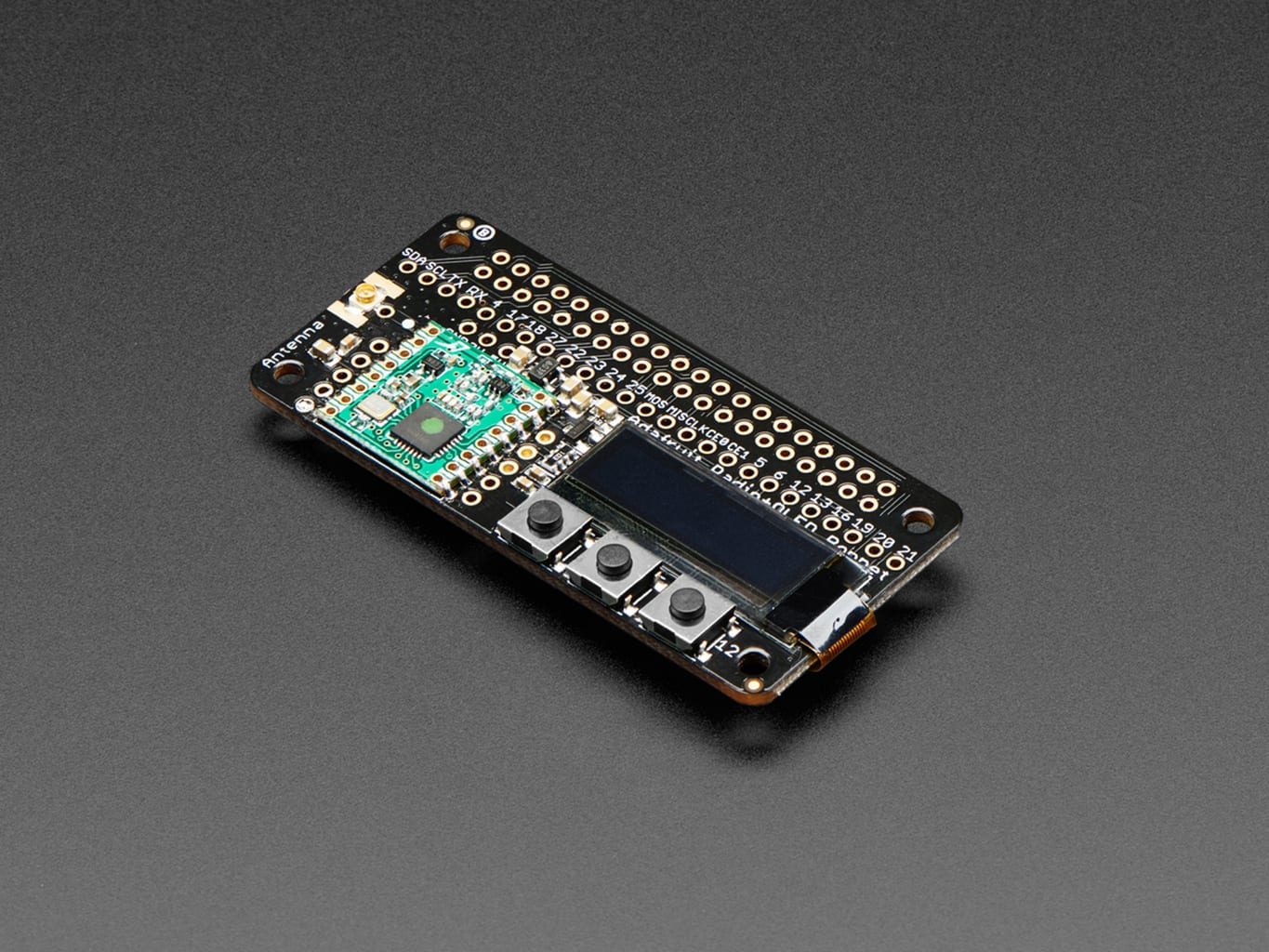
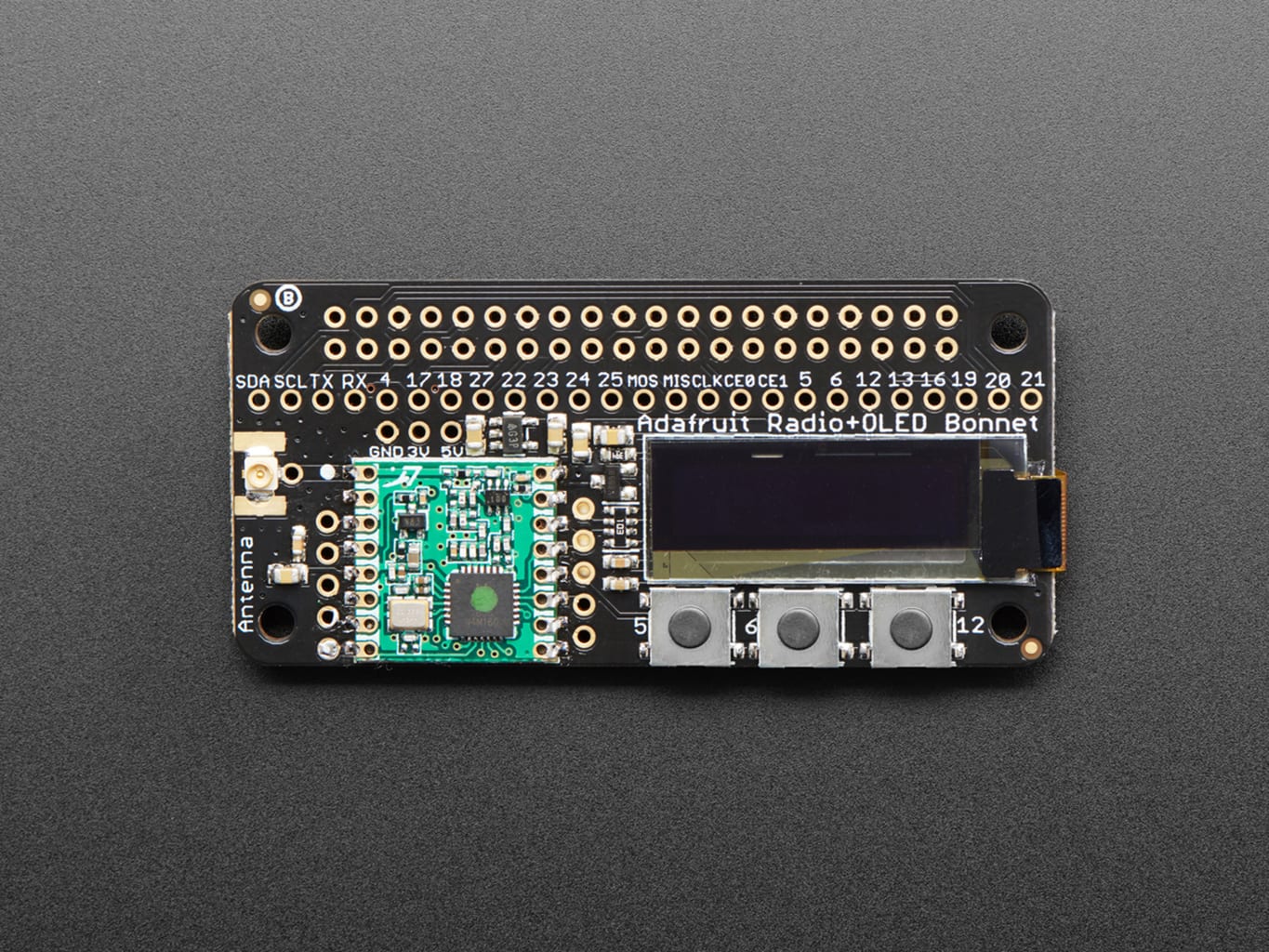
This fabulous Radio Bonnet from Adafruit allows you to add further wireless capabilities to your Raspberry Pi, given that the very latest Raspberry Pi models already feature both Wi-Fi and Bluetooth. If you decide to upgrade your Raspberry Pi with a sub-GHz radio transceiver, this will allow you to communicate over long distances. Simply plug this bonnet directly onto your Raspberry Pi board and you’ll gain a wide range of wireless capabilities to connect to remote nodes; what’s more, the bonnet can also be battery-powered. This bonnet also offers another interesting possibility: easily creating Internet gateways.
By purchasing this product, you’ll not only be getting a radio module, but also a fantastic 128×32-pixel OLED display for status messages, as well as three buttons. Thanks to these, you can create a useful custom user interface and even send text messages. If you wish, you can make use of the Python libraries, which will be a great help if you decide to send or receive radio data packets over a network with other modules that are compatible with yours. Alternatively, you could also decide to create your own personal gateway using the built-in networking capabilities of your Raspberry Pi.
If you compare this module to the 2.4 GHz Wi-Fi/Bluetooth radios already present in your Raspberry Pi, it is obviously much slower as it transmits at 868 or 915 MHz, sub-GHz (‘European ISM’ at 868 MHz or ‘American ISM’ at 915 MHz). However, although the speed is lower, the distance over which you can transmit your data will be significantly greater.
Furthermore, as the design of this compact radio is less complex than that of Wi-Fi or BLE, you won’t have to worry about much other than transmitting data whenever you wish: the data will be received by any other module provided the receiving module is tuned to the same frequency and shares the same encryption key. Receiving modules can also send replies.
This product is also capable of packetisation and error correction, as well as auto-retransmission. Thanks to these features, you’ll have fewer concerns and will also use less power to establish or maintain a link.
This compact radio works extremely well with other microcontrollers, provided they have radios compatible with yours – for example, RadioFruit Feathers – should you want to set up a sensor node network or transmit data within your town or another location of your choice. Bear in mind, however, that you’ll need two or more radios with paired frequencies.
There are four variants of these radio modules: two modulation types and two frequency options. The RFM69s are the best known and easiest to use. LoRa radios are excellent and significantly more powerful, but also more expensive.
This 900 MHz version of the RFM69 radio can be used for transmission/reception at 868 MHz (European) and 915 MHz (American) – it is not possible to determine the exact frequency until the software is loaded, at which point it will be dynamically tuned.
This compact +20 dBm FSK radio comes with several interesting extras, such as the ability to auto-repeat and encryption. Using simple wire antennas, this radio can achieve a range of no less than 500 metres line of sight (LOS), or, using directional antennas and a bit of fine-tuning, it can reach up to 5 km.
- Compact radio with ready-to-use CircuitPython libraries.
- SX1231 module with SPI interface.
- +13 to +20 dBm up to 100mW Power Output Capability (power output selectable via software)
- 50mA (+13 dBm) to 150mA (+20dBm) current consumption during transmission, ~30mA during active radio listening.
- Range of approximately 500 metres, depending on obstacles, frequency, antenna and output power.
- Creates multi-point networks with individual node addresses.
- Encrypted packet engine with AES-128
- Uses the licence-free ISM band: ‘European ISM’ @ 868 MHz or ‘American ISM’ @ 915 MHz.
- Use a simple wire antenna or a spot antenna for the uFL or SMA radio connector.
Each radio is sold individually and can only communicate with radios that share the same model number: the RFM69HCW 915 MHz can only communicate with other RFM69HCW 915 MHz units.
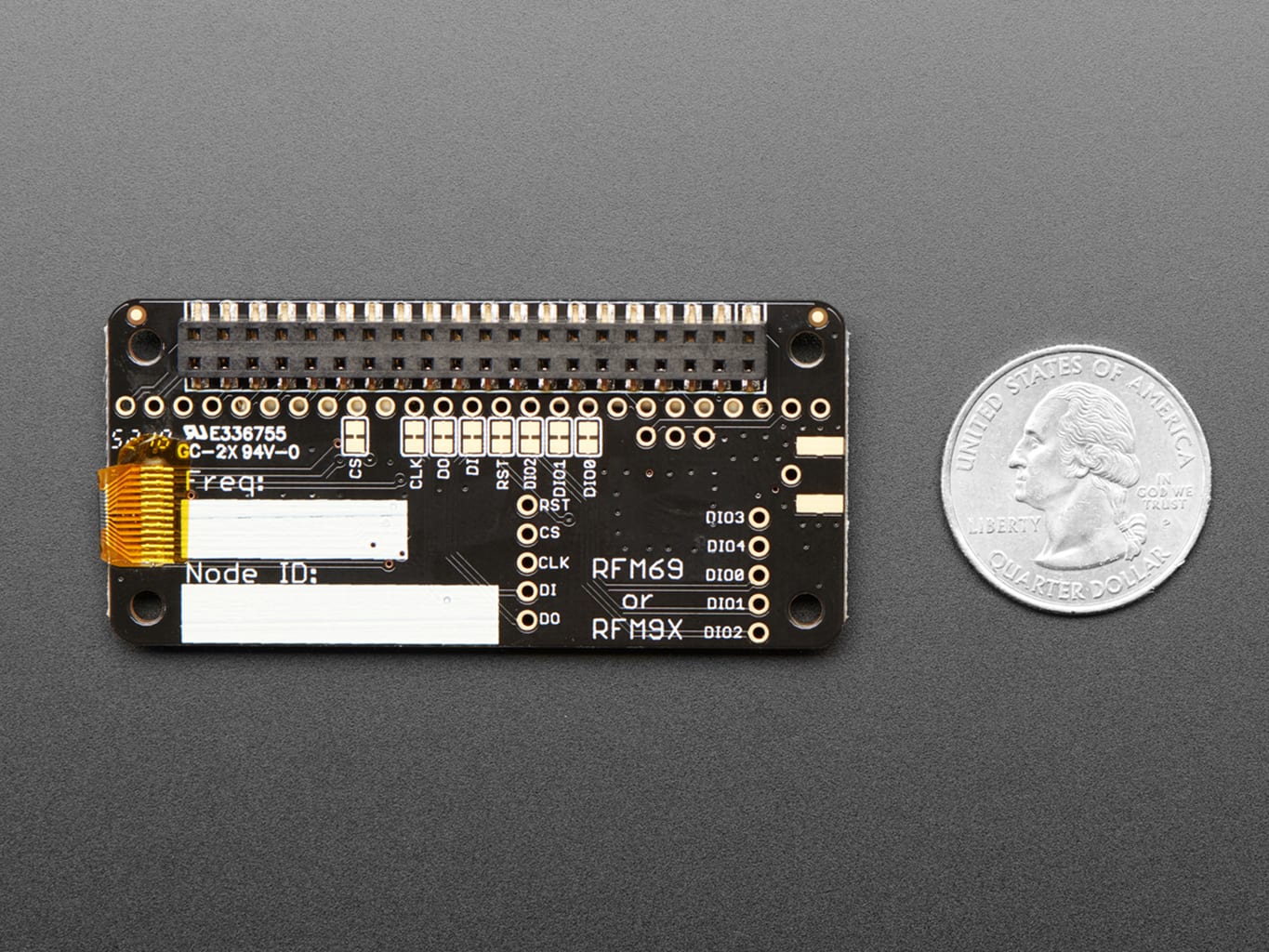
Each Radio Bonnet is supplied fully assembled and ready to use. To create your own antenna, you’ll need to solder a small piece of wire, or alternatively you can connect an antenna via the uFL connector.
Check out Adafruit’s Radio Bonnet with OLED display to find out how to communicate over really long distances.
Transceiver Radio Bonnet, RFM69HCW @ 868 MHz, technical details:
- Dimensions: 65.2×30.7×7.5mm / 2.6″x1.2″x0.3″
- Weight: 10.7g / 0.4oz
Adafruit name: RFM69HCW Transceiver Radio Bonnet – 868 or 915 MHz – RadioFruit [ADA4072]
Show only reviews in English (0)
You must be logged in to post a review.


-
6,46€
Cavi con mini clip coccodrillo (12 pz)
-
3,06€
Cavo Stemma QT/Qwiic a clip a coccodrillo – 15cm
-
41,70€
LoRa Radio Transceiver Bonnet RFM95W
-
13,64€
LoRa Radio Transceiver RFM69HCW
-
8,55€
Matrice LED Charlieplex – 9×16 Blu
-
8,55€
Matrice LED Charlieplex – 9×16 Verdi
-
10,87€
Matrice LED Charlieplex – 9×16 Gialli
-
8,55€
Matrice LED Charlieplex – 9×16 Rossi




 5% discount on every order reviewed!
 Raspberry Pi IN STOCK!

Reviews
There are no reviews yet.